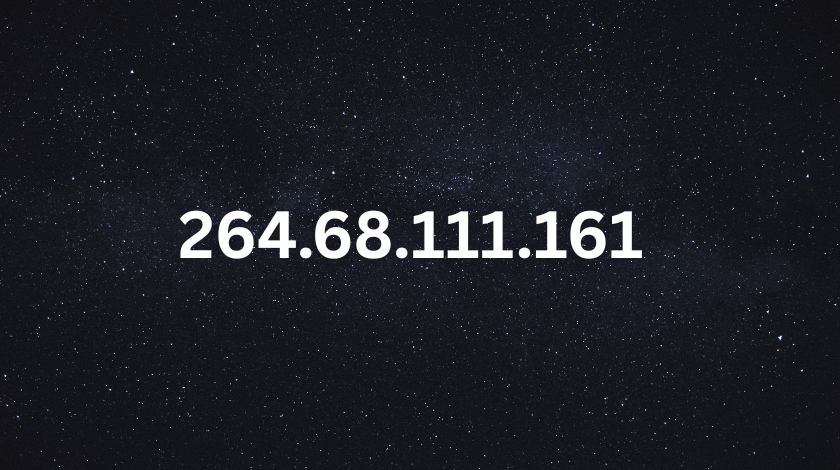
Have you ever been scrolling through your router’s settings or seen a log file and stumbled upon a string of numbers like 264.68.111.161? Maybe it popped up in a tech forum, or you saw it listed as an example somewhere. Your first thought might have been, “Is this mine? Can someone use this to find me?” I remember the first time I saw my own IP address; I felt a weird mix of curiosity and vulnerability. It was like finding out my house had a number that was visible from space, and I had no idea who had a map.
Let’s clear the air right away. That specific number, 264.68.111.161, is almost certainly an example or a placeholder. Here’s a little secret from my early days tinkering with networks: the first part, “264,” is a dead giveaway. In the most common system (IPv4), each of the four numbers can only go up to 255. So, 264 is impossible in a real, working IP address. It’s like having a clock that says 27:00 – it just doesn’t fit the rules. But the feeling it triggers is very real and very important. So, let’s use this as our jumping-off point to talk about what IP addresses really are, what they do, and what they don’t do. I promise to keep this simple, like I’m explaining it to a friend over coffee.
Your Internet Home Address: No Pizza Deliveries, Please
Think of the internet as a massive, global city. Every connected device – your laptop, phone, smart TV, even that Wi-Fi enabled lightbulb – is like a house or apartment in this city. Just like a postal service needs a specific address to deliver a package, the internet needs a way to send data to the right device. That’s the only job of an Internet Protocol (IP) address. It’s a unique label for that moment in time so information knows where to go.
When you type “youtube.com” into your browser, you’re essentially asking for a video file to be sent to you. Your request carries your IP address as the “return address.” YouTube’s servers then use that address to shoot the video data back through the labyrinth of cables and routers straight to your screen. Without an IP, you’re shouting into a void, and the internet can’t talk back to you.
Breaking Down the Code: Why 264 is a Red Herring
Now, let’s dissect our fake friend, 264.68.111.161, to understand real ones. Real IPv4 addresses are made of four blocks, separated by dots. Each block is called an “octet” and can range from 0 to 255. This limit isn’t random; it’s based on the binary math computers use. So, a valid address looks like 192.168.1.1 or 142.250.185.206 (one of Google’s).
-
The First Number(s): Often indicates a rough category or region. For instance, IPs starting with
192.168or10.are almost always private addresses used inside your home network. Your router gives these to your devices. -
The Public Part: The address the outside world sees is the one given to your router by your Internet Service Provider (ISP) – like Comcast, Verizon, or BT. That’s your public IP, and it can reveal your approximate location.
Which brings us to the big question…
What Can Someone Actually Tell From Your IP Address?
This is where myth meets reality. Based on my own experience running IP lookups and helping others, here’s the honest breakdown.
An IP address like a real-world counterpart of 68.111.161.x can typically reveal:
-
Your ISP: It’s very easy to see that an IP belongs to, for example, “Comcast Business” or “British Telecom.”
-
Your Approximate Geographic Location: This is called geolocation. Notice I said approximate. You’ll usually get a city or metro area, but it’s rarely more precise than a zip code. More often, it points to the location of your ISP’s nearest network hub, which could be a town or two over from where you actually live. I’ve had my own IP show a city 50 miles away!
-
A General Reputation: Some services check IPs against blacklists for known spamming or hacking activity.
What it absolutely CANNOT do:
-
Pinpoint Your Physical Address: It won’t give your street name and house number. That’s Hollywood nonsense.
-
Identify You Personally: It’s not linked to your name, social security number, or date of birth directly.
-
Hack You By Itself: Knowing an IP is like knowing the name of a building. It doesn’t mean you can walk in. Direct hacking requires exploiting software vulnerabilities, not just an address.
The Privacy Dance: Should You Be Worried?
So, if it’s not a personal identifier, why any concern? Well, it’s about context and aggregation.
Your public IP is a persistent tracker for your household’s internet activity while you’re online. Your ISP can link it to your account name and address. For websites and advertisers, it’s a key piece of the puzzle. They combine your IP’s general location with your browsing habits, cookies, and other data to build a scarily accurate profile. Ever searched for a hiking backpack and then seen ads for them everywhere? Your IP is part of that tracking machinery.
The risk isn’t typically a lone hacker typing your IP into a dark screen and magically appearing in your webcam. The real concern is corporate and behavioral tracking, or, in rarer cases, being targeted for a denial-of-service attack if you’re running a public server like a gaming host.
Finding Your Own IP and Embracing the “Dynamic” Life
Curious what yours is? It’s simple. Just open Google and type “What is my IP address.” It will show right at the top. Go ahead, I’ll wait. See? Not so mysterious now.
You might also notice it changes every so often – every few days, weeks, or when you reboot your router. This is called a dynamic IP. ISPs do this to manage their pool of addresses. It’s actually a small privacy benefit. A static IP (one that never changes) is usually only for businesses or people hosting websites from home.
Taking Simple Control of Your Digital Shadow
You don’t need to be a tech wizard to add a layer of privacy. Here are practical steps I personally take and recommend:
-
Use a Reputable VPN (Virtual Private Network): This is the most effective tool. A VPN creates an encrypted tunnel from your device to one of its servers. To any website you visit, your IP address is now the VPN server’s IP. If you connect to a server in another country, it will appear you’re browsing from there. It’s like putting on a digital disguise for your internet traffic. Important: Choose a paid VPN with a clear “no-logs” policy. Free VPNs often make money by selling your data, which defeats the purpose.
-
Use a Privacy-Focused Browser: Browsers like Firefox or Brave have strong built-in features to block third-party trackers and fingerprints, reducing how much data can be tied to your IP.
-
Be Mindful of Public Wi-Fi: On an open café network, your data is less secure. Using a VPN here is especially crucial to shield your activity from others on the same network.
-
Keep Your Router Updated: Your router is your home’s gatekeeper. Ensure its firmware is updated to protect against vulnerabilities.
Looking Ahead: The Sea of IPv6
We’ve been talking about IPv4, which has about 4.3 billion possible addresses. The world ran out of new ones years ago. The next generation, IPv6, looks like this: 2001:0db8:85a3:0000:0000:8a2e:0370:7334. It’s longer and uses letters and numbers, providing an almost limitless number of addresses. As we slowly transition, it offers improved security by design, though the core principles of privacy and tracking remain the same.
Conclusion
So, the next time you see a string of numbers like 264.68.111.161, you’ll know it’s a teaching tool, not a threat. Your real IP address is simply your necessary, temporary tag on the internet. It’s not a neon sign flashing your identity, but more like the license plate on your car – visible to those who look, revealing some general information, but not your life story.
The goal isn’t to fear it, but to understand its role in the larger picture of online privacy. By taking a few smart, manageable steps—like using a VPN on public networks and being browser-savvy—you can navigate the digital world with confidence and control. Knowledge, not anxiety, is the best tool you have.
Frequently Asked Questions (FAQs)
Q: Is 264.68.111.161 a real, working IP address I could have?
A: No. In the IPv4 system, no number in the four-part address can be higher than 255. The “264” immediately marks it as an invalid or example address.
Q: Can someone find my exact home address with my IP?
A: Not directly. An IP address typically points to your ISP’s local hub and a general area (like a city). Only your ISP has the direct link between your specific IP at a given time and your billing address, and that information is legally protected.
Q: What’s the difference between a public and a private IP address?
A: Your private IP (e.g., 192.168.1.10) is given to your devices by your home router to talk to each other inside your network. Your public IP is the single address your router uses to represent your entire household to the wider internet. It’s the one you see when you Google “What is my IP.”
Q: Will using a VPN make me completely anonymous?
A: Nothing makes you completely anonymous online. However, a good VPN significantly increases your privacy by hiding your real IP address and encrypting your traffic from your ISP and potential snoopers on your network. It’s one of the best single steps you can take.
Q: How often does my public IP address change?
A: It depends on your ISP. If you have a dynamic IP (most home users do), it can change every few days, when your router reboots, or on a schedule set by the ISP. Some users pay extra for a static IP that never changes, which is useful for hosting servers.